Contents
Independent ecosystem concept · Working product prototype · Source audit: 4 October 2026
An independent fandom ecosystem concept, expressed through a working product prototype.
“Fan đến vì một sự hứng thú nhất thời, ở lại vì tìm được một vị trí cho mình.”

2026 · Phạm Thanh Phú · Mission and identity · research synthesis · product and system logic · implementation direction
Demo artist identities and content; no artist affiliation, live community or partner network is claimed.
#The world and its design logic
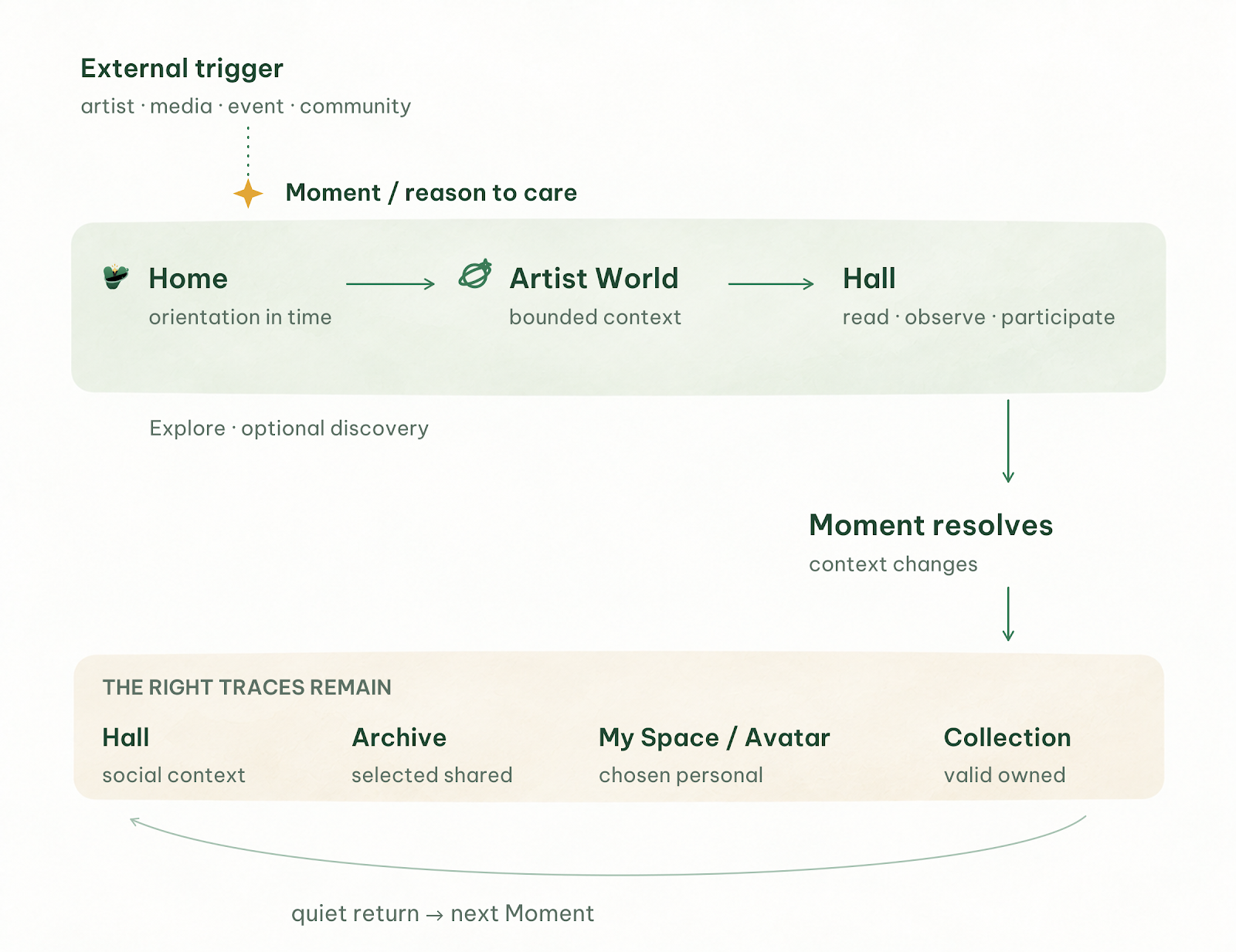
Moment → Place → Position → Continuity

My contribution. I composed the mission and identity, synthesized research, defined product and system logic, and directed implementation. An earlier merchandise case supplied the question: what happens after the transaction? I developed an independent model with free community at its center.
Research to design. Identity, participation, community and memory informed the intended path from observing to contributing and from shared experience to personal meaning [R1–R11, R29, R30]. Persistent named rooms were a behavioral reference for Hall [R16]. These were design inputs; no direct Vietnamese fan research has yet been conducted.
Ecosystem approach. The structural lens asks which activities depend on which actors and handoffs [R35, R36]. I separated external attention, internal places and rules, operating authority, and conditional delivery. That defines a coordinating model, without implying secured partners or a live community.
#Home gives interest a time context
A song, social clip, event or friend gives a fan a reason to care. Home helps that interest find its current context.

Fan state. The fan arrives with temporary attention, not necessarily a destination or a commitment to join. Outside platforms remain sources of attention; the map does not imply content imports or partner integrations.
Design decision. Home answers what matters now through current, recent and upcoming Moments. Time provides orientation before a feed asks the fan to consume more. A Moment can carry the fan into an Artist World and its relevant room; Explore provides another route when the fan is still discovering.
What carries forward. The trigger gains a time and a bounded fandom context. Home is the first product expression of the world already introduced in the ecosystem map. The pictured content, artist identities and Hall voices are demo fixtures, not evidence of live artist presence or community activity.
#Artist World gives attention a place
The Moment becomes part of a recognizable artist and fandom context that the fan can enter again.

Fan state. Interest now has an artist anchor, but the fan still needs to understand where they are and where participation belongs. Artist World brings identity, current activity, conversation and selected history into one scope.
Relationship. A Moment supplies the reason to enter. Artist World gives that reason a boundary; Hall offers social participation, while Archive offers selected shared memory. The destinations inherit context rather than behaving as unrelated modules.
Choice. This is a designed path, not a compulsory funnel. A fan can arrive through Explore, follow a World, return directly to Hall, or revisit a memory. Position means a personally legible way to participate and express meaning, not a fan rank. Current names and paths remain product hypotheses to test with newcomers.
#Hall keeps a recurring social context
Shared attention needs somewhere to become repeated conversation. Hall remains available after the Moment ends.

Participation. Guests can read public Hall. Signed-in nonmembers can post, reply and react. A valid membership adds private Lounge and Q&A access; expiry does not remove access to the public community. Reading before speaking is a legitimate way to enter.
Three separate rules. Access decides who may enter. Mode decides whether the room is chat or Q&A. Lifecycle decides what can happen now. A public Moment room can move from preparation to active to ended and read-only; Phòng chung remains recurring. Paused is a distinct read-only state.
What remains. Selected eligible public context may later become shared memory, while recurring rooms remain available on quiet days. Private or member-only material stays outside public Archive. These local rules demonstrate scoped behavior; they do not establish real artist responses, staffed moderation or production security.
#Archive preserves selected shared memory
When a Moment resolves, some public context can become a shared record. Not every conversation should persist.

Why it follows Hall. Hall holds the experience while people participate. Archive gives selected eligible public traces a form that can be revisited after the peak. It preserves shared context rather than keeping all activity available forever.
Boundary. Private Q&A, cancelled or invalid sessions, rights or media-invalid contexts, and material outside the correct World do not become public memory. Ending a room does not automatically archive its messages. Eligibility and selection matter; the visible historical content is illustrative.
What it does not contain. A collective record is only one residue of a Moment. The recurring room, a fan’s followed Worlds, personal curation and valid owned objects carry other forms of continuity. This choice creates curation work and leaves some traces behind; it is not simply a storage feature.
#My Space keeps the fan’s chosen meaning
A shared experience can matter differently to each person. My Space lets the fan carry their own part forward.

Personal continuity. The fan chooses which part of fandom belongs in their own identity and memory. That selection need not match the collective Archive. My Space is a personal place that can carry chosen expression across Moments and fandom contexts.
Design decision. The fan chooses compatible owned objects and surfaces, previews a placement and saves it. A constrained room composes the display instead of making the fan manage a full scene editor. Compatibility and public versus private expression remain explicit rules.
Inspectable behavior. The canonical audit records placing an eligible demo object and removing it while ownership remains. Local profile guards protect private state across sign-out and profile changes; they are client-side protections. Whether room curation is meaningful to Vietnamese fans remains unknown. The virtual-possession study behind this lens involved 21 U.S. teenagers, not VieWorld users [R29].
#VieCollect makes ownership an optional layer
Some fandom objects may carry memory and identity over time. Purchase is one way to acquire them.

Reason to exist. Commerce is an optional input to continuity. An eligible object may remain in Collection and become chosen Avatar or My Space expression. Community does not require spending, and payment does not make someone a more legitimate fan.
Separate states. Acquisition, ownership and display are different. Saved, cart, preorder and paid states are not ownership; a valid receipt or grant establishes provenance. Removing a display preserves a valid owned object.
Delivery boundary. Physical-only purchase does not unlock a digital object. Hybrid remains conceptual; physical delivery and digital entitlement would carry separate obligations. Rights, inventory, payment, fulfillment and support remain operating requirements, not outcomes established by a demo order.
#What remains after a Moment
Continuity is distributed across the ecosystem. Archive is one form of continuity, not the continuity feature.

Different carriers. Hall keeps recurring social context. Archive keeps selected public shared memory. Identity, followed Worlds, My Space and chosen expression keep a personal position. Collection keeps valid owned objects and provenance. Official or member access may expire without removing basic public community access.
Quiet return. The fan can return to a familiar room, a shared trace or their own chosen meaning without needing a new sale or artist post. The next Moment can orient activity again while valid persistent states remain. This is the intended experience, not an automatic retention engine or an observed return pattern.
The open question. What should persist, what should resolve, and which remaining trace would give a fan a reason to return? Those choices connect the places into a world and define the next research task.
#Shared rules make the places one system
The relationships the fan experiences depend on shared objects, scope and responsibility boundaries.

Connections. A valid Moment can orient Home, contextualize Artist World and determine a Hall room’s state. Selected ended public context can become Archive memory. An eligible owned digital object can appear in Collection and be worn or displayed through compatible personal expression.
Invariants. World scope, time, access, identity, provenance, selection and privacy travel with these relationships. Access is not identity; acquisition is not ownership; ownership is not display. Private state must not leak into public projections. A visually coherent interface cannot substitute for those rules.
Tradeoff. I kept permanent places few and capabilities contextual. Curated memory, constrained composition and free public participation take priority. Selected rules are inspectable; real ecosystem coordination still requires actor agreement.
#What the prototype makes inspectable
A working local frontend turns selected ecosystem relationships into behavior that can be checked.

Built slice. React, TypeScript and Vite express selected rules for room access and lifecycle, Q&A visibility, ownership and personal placement. The canonical audit records local guards and browser checks, including display removal that preserves ownership and protected state at sign-out.
Recorded verification. The Truth Audit dated 4 October 2026 recorded 576 passing tests across 63 files, plus passing typecheck, build and supporting checks. These results support prototype and domain coherence; they are not market, load, rights or production-security evidence.
Practical limit. Production authentication, server authorization, synchronization, realtime infrastructure, full moderation, payments and fulfillment remain outside the slice. Audit scope refers to the canonical local build; the public demo may lag, and production infrastructure remains outside the prototype.
#Live services need accountable operators
Local rules can reject an action. A real promise needs authority, handoffs and an owner when delivery fails.

Two service examples. A real member Q&A would require intake, moderation, selection, Artist Team approval, publication and incident handling. A physical object would require rights, seller and stock, payment status, fulfillment, returns and support. The service view exposes the work behind a simple fan interaction [R26].
Authority and stewardship. Artist or Artist Team retains creative and approval authority. A World Team would carry authorized lifecycle, curation, publishing and moderation work. Delivery partners enter only when a specific promise requires them. Every handoff needs a truthful status and an accountable failure owner.
Current boundary. These are designed requirements, not staffed services, verified official identities or secured partnerships. Demo artist content does not confer rights. The operating layer remains a separate feasibility question even if the frontend behaves coherently.
#Expansion follows evidence and authority
Capabilities can multiply while permanent places stay few. Each new promise changes the responsibility model.

Participation. Play, Living Home and richer Dấu mốc could deepen participation, orientation and chosen history. Artist Avatar Live would require approved material, disclosed session state and accountable human control, not an autonomous artist persona.
Real-world and operating work. VieWithYou, VieCharity and fan-initiated shows would require consent, verified partners, fair allocation and feasible delivery. Official stewardship, shared backstage tools and domain contracts would require authority and privacy boundaries. Conversation may inform internal learning, but is not representative research.
Gate. First establish free-community value. Then require actor alignment, trustworthy provenance and capacity to deliver each promise. Add capabilities only when those conditions exist, without automatically creating permanent tabs.
#The next test is quiet return
Will people return because the place and people begin to matter?

Start with real behavior. I would begin with 6–10 fan interviews and artifact walkthroughs, then task-based Home, Hall and My Space usability [R19, R25]. A closed test with 20–50 participants would use fictional or original context, without commerce, paid membership or real-artist assets.
Observe and interpret. Active and quiet periods would reveal read-only returns, repeated rooms and recognition alongside contributions. Operator interviews and qualitative follow-up would help distinguish meaningful return from novelty or reminders [R20]. In parallel, I would map one prospective official service before accepting a real promise.
Decision. No VieWorld interviews, live analytics or retention results are reported here. The contribution is an authored world with an inspectable slice and explicit operating boundaries. The next question is whether that world becomes worth returning to. I designed the world first, then built an executable slice of it.
#Selected references and evidence
Reference identifiers follow the full case. Titles below link to the cited sources.
[R1] The Psychology of Fandom and Parasocial Experience. Oxford Handbook of Media Psychology (2025). ↗
[R3] Groene and Hettinger. Are you “fan” enough? The role of identity in media fandoms (2016). ↗
[R4] The Psychology of Online Lurking. Oxford Handbook of Cyberpsychology (2018). ↗
[R5] Sun, Rau and Ma. Understanding lurkers in online communities: A literature review (2014). ↗
[R7] Blanchard. Testing a model of sense of virtual community (2008). ↗
[R8] Abfalter, Zaglia and Mueller. Sense of virtual community: A follow up on its measurement (2012). ↗
[R9] Jenkins et al. Confronting the Challenges of Participatory Culture. MIT Press. ↗
[R10] MIT OpenCourseWare. Fans and Fan Cultures instructor insights (2024 course). ↗
[R16] Discord. Server Guide FAQ. ↗
[R19] Nielsen Norman Group. Contextual Inquiry. ↗
[R20] Nielsen Norman Group. Triangulation: Get Better Research Results by Using Multiple UX Methods. ↗
[R25] GOV.UK Service Manual. Plan user research for your service. ↗
[R26] Nielsen Norman Group. Service Blueprints: Definition. ↗
Research scope. R29 is a qualitative study of 21 U.S. teenagers; R30 is a narrative review. R35 and R36 are conceptual ecosystem lenses. None validates demand, belonging or retention for VieWorld.
Canonical case evidence. The latest VieWorld Ecosystem Build Final Presentation, its original screenshots and case visuals, and the Final Truth Audit dated 4 October 2026 form the source set. Engineering results are reported from that audit, not freshly rerun checks. The full case retains the complete bibliography and detailed evidence boundaries.
#More views of the build
Explore remaining diagrams, product views and identity artwork






#Original editable presentations
#Related work
VieSHOP: Fan-Centred Merchandise System supplied an earlier merchandise question. Artist Fandom Page & Fan Dashboard remains a separate concept. Who Owns the Fan Promise? examines accountability after a transaction is accepted.