Contents
#Can Customers Still Understand, Preserve, Contest, and Recover?
Evidence-Based Product Operations Case
A privacy-first analysis of 35 coded Threads narratives, Shopee policy, and Vietnam consumer-protection baselines
Public evidence only · Research cut: 5 August 2026 · Not commissioned by Shopee

The restriction is one platform event. The customer may still be waiting on an order, refund, balance, benefit, or explanation after that event has been recorded internally. This case asks what minimum resolution pathway should remain visible without requiring the platform to expose its fraud model.
#Executive Summary
- Problem: A restriction can affect more than account access. Orders, refunds, balances, benefits, and future transactions may also become uncertain.
- Evidence: 35 public customer narratives were collected and screened; 22 form the core analytical sample. The corpus is purposive and supports pathway analysis, not prevalence or wrongdoing claims.
- Observed issue: Customers in the sample reported different levels of reason clarity, appeal effort, affected interests, and recovery outcomes.
- Proposal: An Explainable Resolution Case — one coherent customer-facing source of truth for the current issue, affected interests, required action, review state, timing, outcome, recovery state, and remaining remedy.
- Business hypothesis: Better resolution quality may improve benefit recovery, customer experience, return, repeat purchase, and retention without weakening enforcement controls. This must be tested with Shopee internal data; the public case does not claim that the solution is proven.
This page is the portfolio summary.
The full 22-page case includes the privacy-first evidence register, detailed gap matrix, policy/legal source cards, claim-to-source map, pilot design, metric definitions, guardrails, and evidence boundaries.
#1. Case Framing — Restriction interrupts a customer benefit, not just an account
Customers use a marketplace to achieve a downstream benefit: receive a product, complete a time-sensitive purchase, recover a refund, use stored value, or maintain account continuity.
The research object is therefore the post-restriction customer-resolution pathway, not the restriction decision in isolation.
Key distinction: Internal case closure does not necessarily mean the customer problem is resolved.
#2. Research Question and Scope
After a marketplace restricts a customer account, does a usable resolution pathway remain visible and actionable to the customer?
The case separates three questions:
- What customers publicly reported experiencing.
- What Shopee publicly states in policy/help and complaint processes.
- What current legal or regulator baselines require or make available, subject to applicability.
Out of scope: proving individual restrictions erroneous or unlawful; estimating platform-wide failure rates; reverse-engineering fraud controls; inferring undocumented Shopee operations; or claiming the proposed intervention works before testing.
- Evidence and method
- Public narratives were collected manually and purposively.
- The coded register used in this case contains 35 publicly linked Threads posts and replies: 22 core / 4 adjacent / 4 appeal-recovery context / 5 excluded.
- Broader Facebook screening was not included in the coded corpus.
- Records were screened for sufficient pathway detail, relevance to the research object, and near-duplicate content.
- Usernames, screenshots, profile URLs, direct social links, and verbatim posts are excluded from the portfolio export.
- Evidence supports reported pathway states and customer-interface signals. It does not establish prevalence, representativeness, a common root cause, wrongdoing, or legal violation.
#3. Observed Customer Journey — The path fragments after restriction
Different initiating events converged into a partially shared post-restriction resolution problem:
Intended benefit → restriction/cancellation → search for explanation/support → appeal/review in some cases → mixed recovery or unresolved outcome
Four recurring analytical signals matter:
- Reason opacity — some customers could not identify a sufficiently specific reason.
- Appeal effort — some reported repeated contact or evidence submission.
- Mixed recovery — outcomes ranged from reopening to delayed recovery, relock, permanent lock, or unresolved/unstated outcomes.
- Affected interests beyond access — orders, purchases, balances, benefits, or account continuity could also be involved.
This supports studying resolution quality, not concluding that all restrictions share one failure mode.
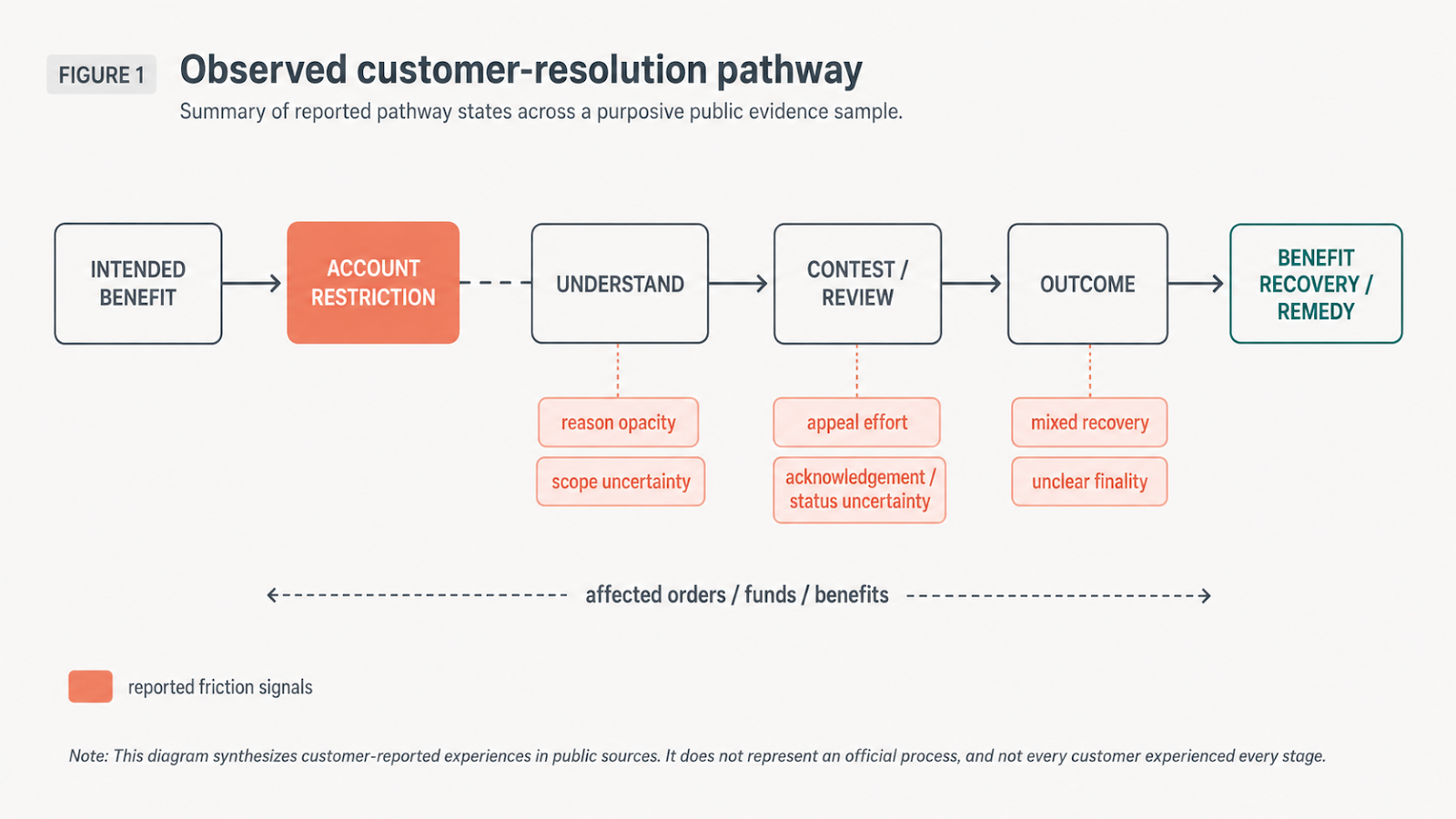
Caption: Synthesis of reported pathway states across a purposive public evidence sample; not an official Shopee process.
#4. Minimum Contestable Restriction — What should remain possible
For this case, operational contestability means preserving four customer functions:
UNDERSTAND → PRESERVE → CONTEST → RESOLVE / ESCALATE
The customer should be able to determine:
- what is restricted and what is affected;
- the safe-to-disclose reason or rule at issue;
- where and how to submit a complaint or evidence;
- current review state and expected timing;
- what happens to pending orders, refunds, balances, and benefits;
- the reasoned outcome and practical recovery consequence;
- what internal or external remedy remains.
This is an operational minimum for the case, not a claim that every element is independently mandated by one law.
- Policy and legal baseline Three baselines are kept separate: 1. Shopee policy: broad account-enforcement discretion plus published restoration and complaint routes. 2. Vietnam consumer-protection law: complaint receipt/resolution duties, intermediary-platform responsibilities, and recognized dispute-remedy routes. 3. Electronic-transactions and e-commerce platform duties: potentially relevant platform-specific information, complaint-handling, coordination, and record obligations, subject to the exact statutory classification and provision applied. Important: Shopee's published complaint timing, statutory complaint acknowledgement, and statutory negotiation timing are separate clocks. The case does not merge them into one SLA. Full provisions, source cards, URLs, and applicability notes are retained in the full case. - Observed Gap Matrix Each Minimum Contestable Restriction element is compared against public narratives and published baselines using three evidence states: - Observed gap — a missing or insufficient element is directly reported. - Partially evidenced — a relevant feature appears, but completeness or consistency cannot be determined. - Not evidenced — cannot determine — the public corpus lacks enough visibility. This distinction prevents “not reported” from being converted into “Shopee does not do this.” The strongest directly observed issue is reason/explanation opacity in a subset of narratives. Other areas worth testing are affected-interest visibility, complaint acknowledgement, review-state visibility, timing certainty, recovery handling, and remedy continuity. - Customer Remedy Ladder The pathway should remain intelligible even when the platform reaches an internally final decision: 1. Read the restriction notice and published restoration requirements. 2. Use the internal complaint/restoration process and retain submitted evidence and dates. 3. Seek an actionable outcome: decision, practical consequences, and remaining action. 4. Use negotiation or supported negotiation where statutory conditions apply. 5. Other recognized routes may include mediation, arbitration, or court, subject to jurisdiction, agreement, procedure, and facts. > Key distinction: An internal case can be closed while the customer problem remains open. >
#5. Platform Governance Diagnosis — Four interface control problems worth testing
- Open diagnosis ### 5.1 Enforcement decision ↔ customer explanation The platform may need to protect detection signals, but that does not eliminate the need for enough explanation to make a decision contestable. ### 5.2 Restriction ↔ affected interests The resolution object may include orders, refunds, stored value, benefits, and linked-service access — not only account reopening. ### 5.3 Complaint intake ↔ review visibility A contact channel is not the same as a visible case state. A customer may still lack a coherent source of truth for acknowledgement, evidence required, current stage, next step, or expected update. ### 5.4 Internal finality ↔ remedy continuity After internal review ends, the customer still needs to know what was decided, what happens to affected interests, what is actually final, and what route remains.
#6. Resolution Pathway Components — Make resolution explainable end to end
The proposal is one integrated pathway with four connected components:
| Component | Role |
|---|---|
| A. Restriction Notice | Opens the pathway with state, affected scope, safe reason category, consequences, and appeal route. |
| B. Explainable Resolution Case | Becomes the customer-facing source of truth for the case. |
| C. Affected-Interest Protection / Recovery | Keeps orders, refunds, balances, benefits, and other practical consequences visible. |
| D. Reasoned Closure & Remedy | Shows the decision, recovery state, remaining internal action, and external remedy where applicable. |
#Explainable Resolution Case — Proposed source of truth
The conceptual case surface answers:
- What is my current state?
- Why am I here?
- What is affected — and what remains protected?
- What supports the issue at a safe-to-disclose level?
- What do you need from me?
- What is happening now?
- When will I hear back?
- What was decided?
- What happens to my affected interests?
- What can I do next?
Design principle: At any point, the customer should be able to determine where the issue sits, why it is there, what is affected, what information is required, what happens next, and when the next state is expected. Explainable does not mean disclosing everything.
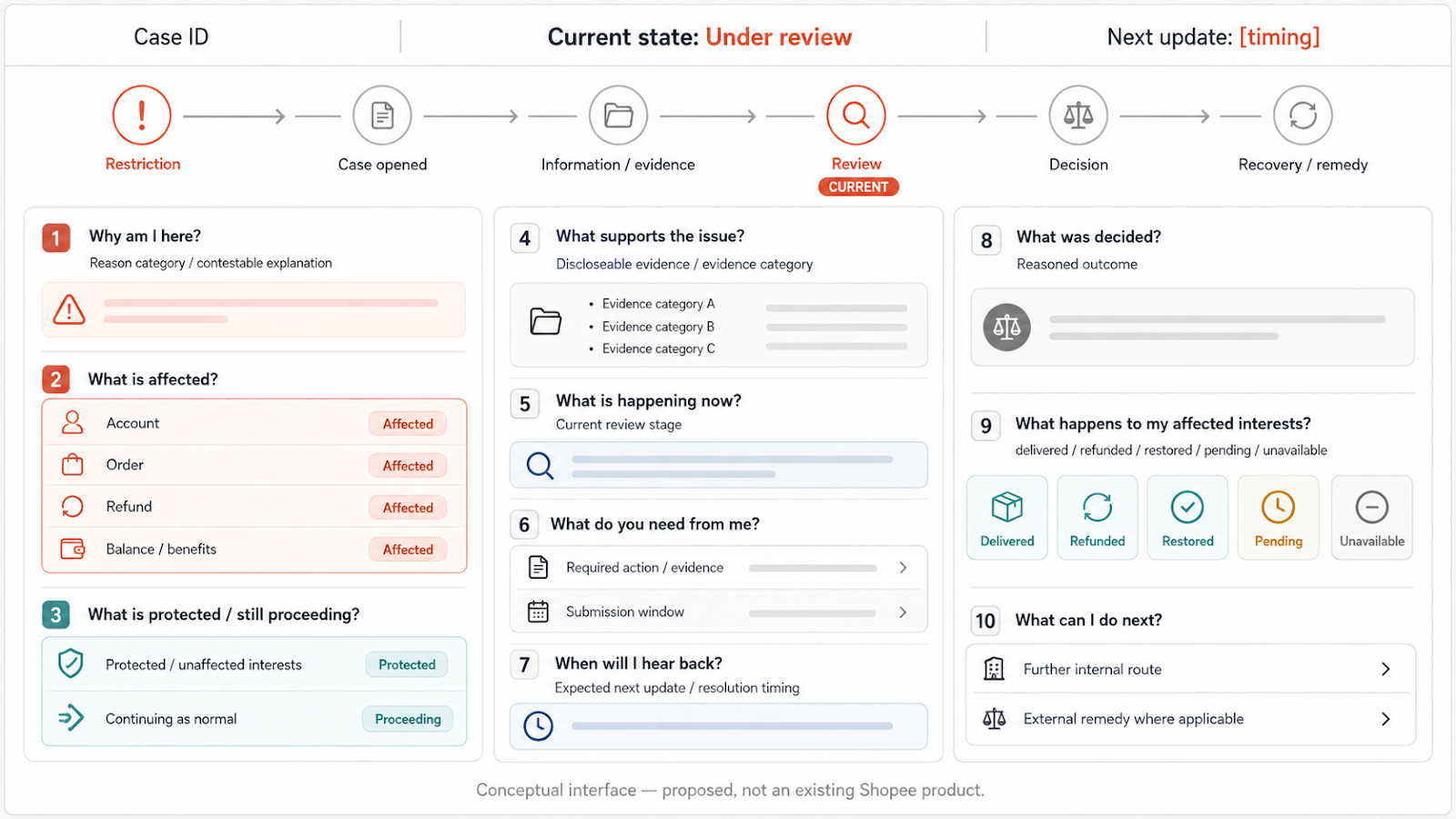
Caption: Conceptual customer-resolution interface; proposed, not an existing Shopee product.
#7. Recommended Pilot — Test resolution without changing detection rules
Hypothesis: For a defined subset of eligible restricted buyer accounts, one coherent Explainable Resolution Case may reduce uncertainty and repeat support effort while improving resolution experience and post-resolution customer return, without materially weakening enforcement controls.
First pilot principles:
- define eligible account-restriction types and explicit high-risk exclusions; - do not change substantive detection thresholds or enforcement criteria; - test the resolution interface and cross-functional handoffs; - compare eligible cohorts using random assignment where feasible or a controlled phased rollout; - pre-register exclusions, metric definitions, comparison windows, guardrails, and stop conditions; - determine sample size from Shopee baseline volume and variance rather than inventing public-case targets. - Headline metrics and guardrails Headline metrics - Time to Customer Certainty - Resolution Completeness - Benefit Recovery Rate - Repeat Contact Rate - 30-day Customer Return Rate The pilot tests whether better resolution quality affects subsequent customer behavior. It does not assume that restoration automatically produces return or retention. Guardrails - incorrect restoration or enforcement-reversal risk; - fraud or financial loss; - sensitive-control disclosure; - reviewer workload or backlog; - privacy and security incidents. Detailed definitions, observation windows, survey items, retention logic, and stop conditions are provided in the full case.
#8. Bounded Findings and Unknowns — What this case can support
#Evidence supports
- Customer-reported difficulty or uncertainty can occur at multiple points in the post-restriction pathway.
- Reason opacity appears directly in a subset of core narratives; appeal/contact and recovery outcomes are mixed.
- Affected interests can extend beyond account access.
- Public policy and legal sources preserve multiple resolution and remedy mechanisms alongside enforcement discretion.
#Evidence does not support
- a Shopee-wide prevalence or failure rate;
- a common root cause across the core sample;
- a conclusion that an individual restriction was wrongful or unlawful;
- an inference that anything absent from a sampled narrative was absent from Shopee's actual process;
- a claim that the proposed Explainable Resolution Case improves business outcomes before a pilot is run.
Independent portfolio case study · Public evidence only · Research cut: 5 August 2026