Contents
#One listing changed the starting question
In the exploratory Shopee pull for Anh Trai Say Hi, one card listing from one seller showed more than 30,000 units sold. The pull was not exhaustive, so I use that number only as a demand signal; it was enough to shift the product question toward what an official 12-card pack would need to do better.
Merchandise Initiative / Outside-In Working Case · Developed Work Sample
Updated 16 August 2026 · Public evidence only · Not commissioned by DatVietVAC

Core question: Can DatVietVAC turn already-observed demand for artist cards into an official 12-card product that fans carry, share, display and trade in everyday life — then use repeated drop evidence to earn a gated collectibles product line?
#Executive Summary
- Product promise: Official enough to trust. Personal enough to carry. Simple enough to share.
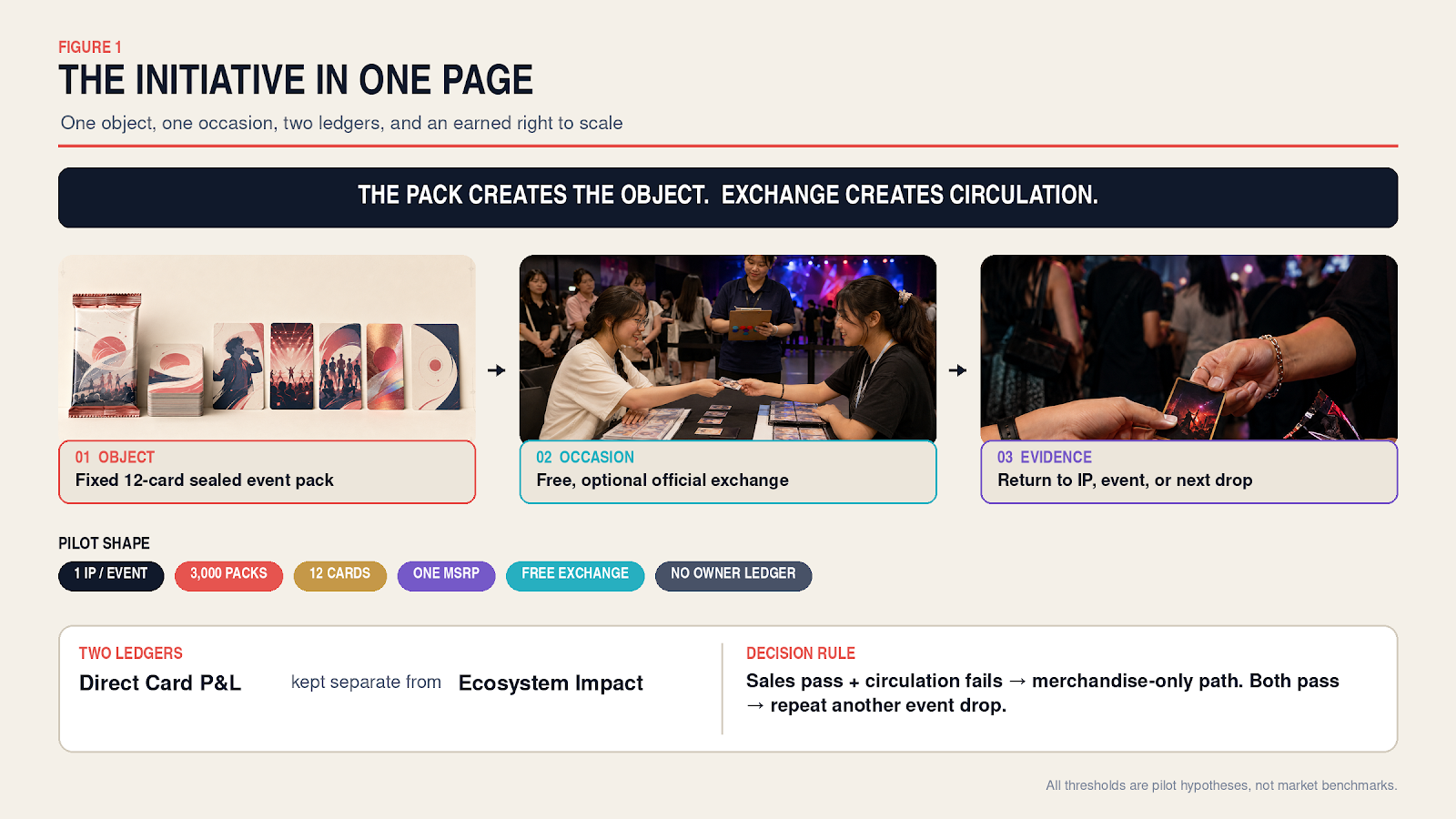
- Pilot unit: one IP/program · one launch/drop occasion · one sealed 12-card pack · one public MSRP.
- Working price: VND89K preferred working MSRP when it preserves a visibly better official quality bar; VND79K remains a value-engineering sensitivity only if that quality bar survives.
- Authentication: no owner registry, crypto or NFC requirement. Build a reproducible physical manufacturing signature across substrate, print, surface, cut and packaging.
- Behavior thesis: 12 cards create enough social inventory to keep, gift, share, carry, display and trade. Event/concert moments can concentrate launch demand; everyday life is where circulation is tested.
- Social-object kill rule: if packs sell but both designed interaction and post-drop daily circulation remain weak after one reasonable iteration, kill the broader social-object thesis. The card may remain merchandise if its direct economics justify it.
- Scale logic: prototype → drop pilot → repeated product line → conditional annual box → collectibles pod → selective internalization. Each stage is an earned option, not a default roadmap.
Strategic bet
DatVietVAC does not need to manufacture community. It needs to issue an official object good enough to circulate, give fans enough cards to keep and share, and then observe what actually happens after checkout. Direct card P&L must still stand on its own.
#1. The Human and Business Opportunity
DatVietVAC already has a dense entertainment ecosystem: programs, artists, content moments, concerts, distribution and D2C surfaces. The outside-in problem is therefore not lack of content. It is whether the IP owner can turn visible existing demand for artist cards into an official product that is materially better and worth carrying.
In the exploratory Shopee pull used for this case, one Anh Trai Say Hi card listing from one seller showed more than 30,000 units sold. Hundreds of other products and sellers were visible, but the pull was not exhaustive across listings, product lines or platforms. This is directional demand evidence, not market size, and it does not by itself establish the authorization status of each seller or listing.
The observed category is therefore not starting from zero. The product opportunity is to compete with existing outside-channel supply through official content access, stronger material/print/finish, consistent packaging and a recognizable manufacturing signature; seller authorization still needs to be checked rather than assumed.
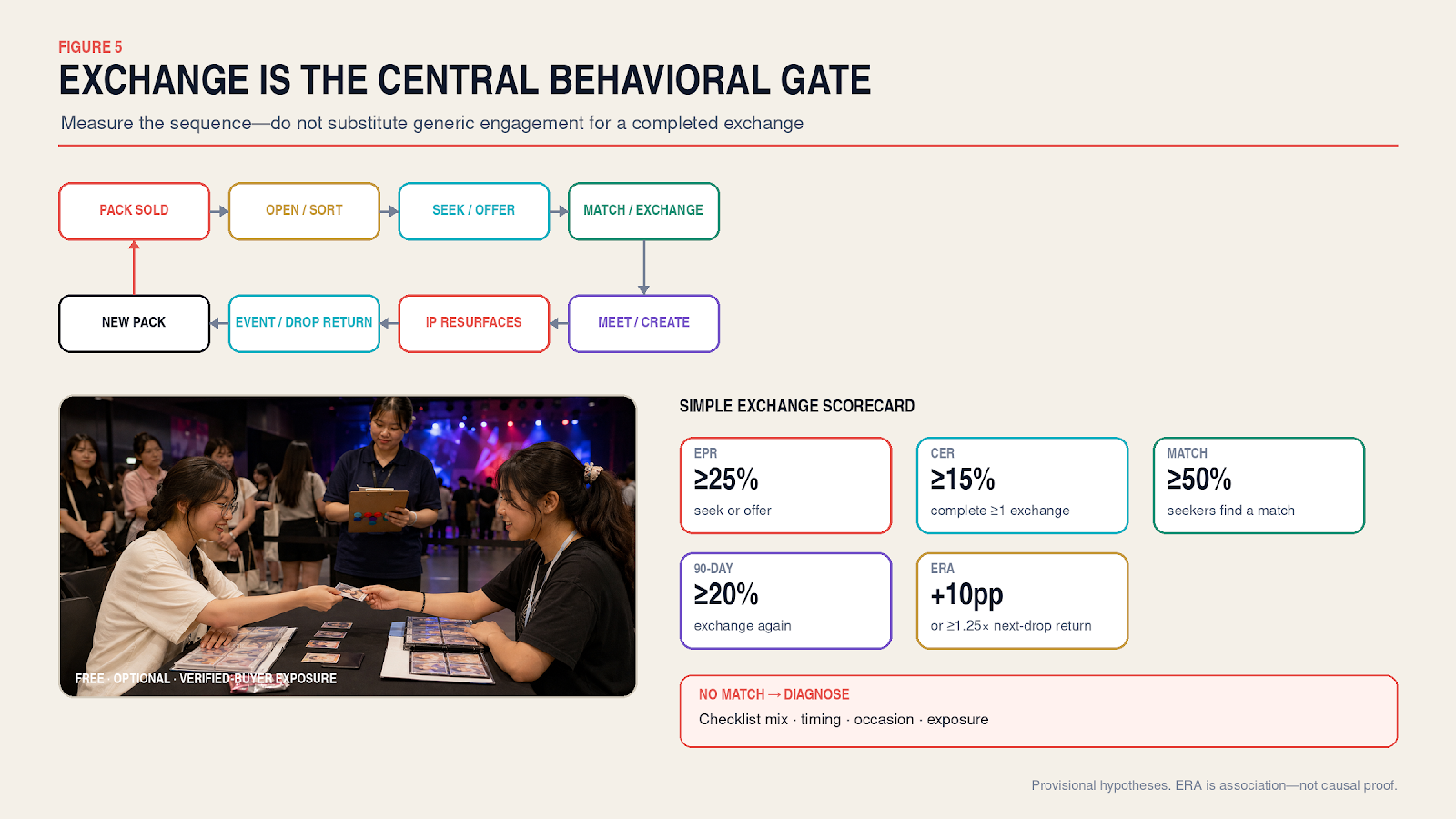
The human mechanism is broader than event trading. A 12-card pack gives one buyer enough inventory to keep favorite cards, gift one or two to friends, trade duplicates, carry a card in a phone case or card holder, attach it to a bag, photograph it or post it. Events can concentrate launch attention, but daily life is the real usage environment.
Working thesis: the card is an object, a signal and social inventory. The company can make the object trustworthy and easy to circulate; fans decide whether repeated sharing, carrying, display and exchange become belonging.
The mechanism is plausible, not guaranteed. If the card sells but remains socially inert after checkout, it may still be a valid merchandise SKU. It does not automatically earn a community thesis.
#2. Product Architecture: Program → Drop Occasion → Pack → Conditional Annual Box
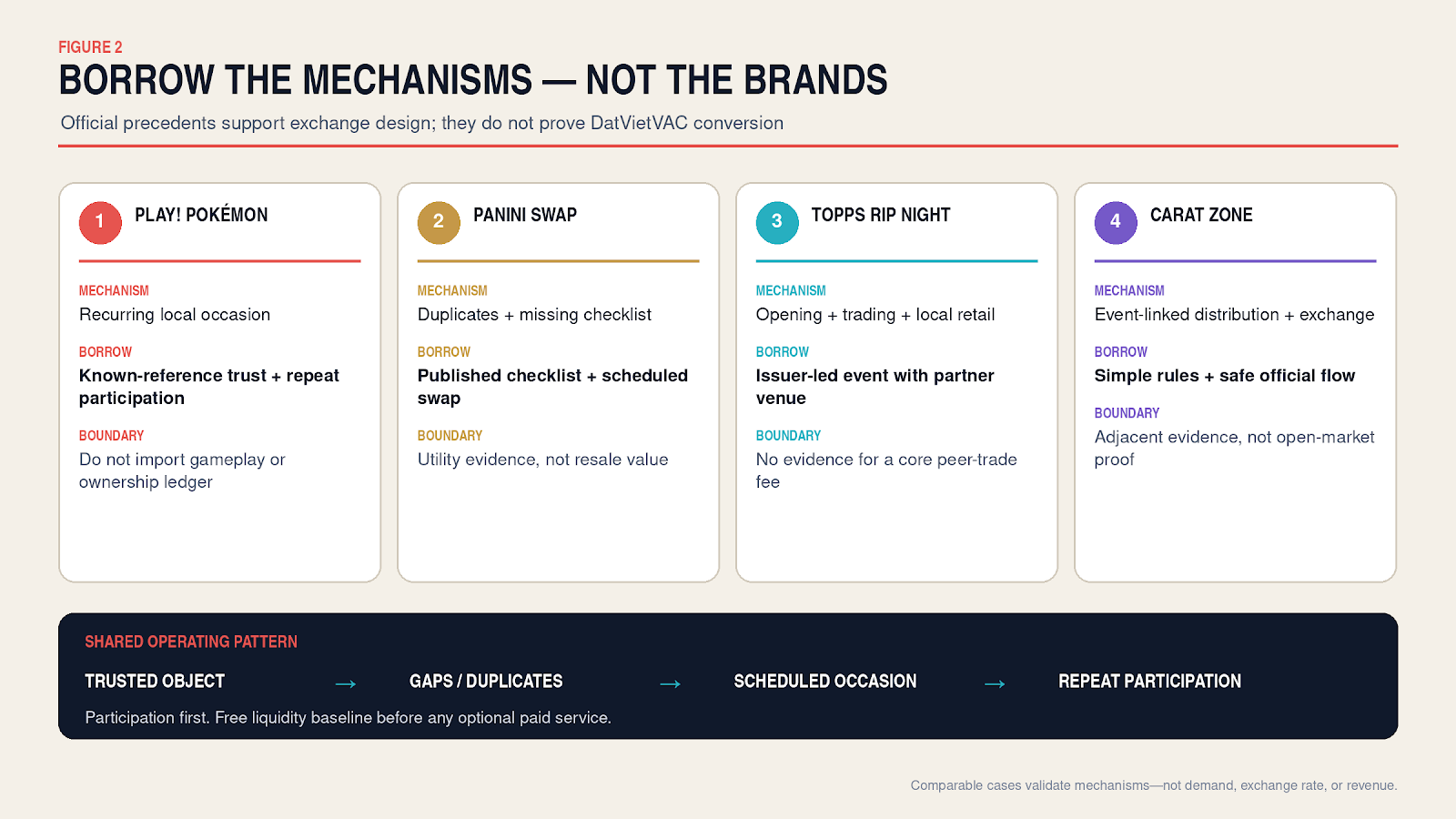
The architecture fixes four levels:
- Program / IP — provides the year-long content universe, rights framework and common issuer/manufacturing grammar.
- Drop occasion — creates freshness and a reason to buy now. A concert/event is a strong pilot catalyst, but later drops can also follow program milestones, artist moments or other culturally meaningful releases.
- Pack — the commercial unit: always one sealed 12-card pack in the pilot and base product-line design; its value should continue after the launch occasion through everyday circulation.
- Annual box — a later program-level archive/collector product: 12 sealed packs × 12 cards + one collectible, considered only after multi-drop gates pass.
This hierarchy prevents two common drifts: redesigning the pack every time the occasion changes, and assuming a box simply because a program is large.
#Why 12 cards
The earlier two-card proposition was too thin. Twelve cards create a stronger opening ritual, more visible value-in-hand, room for a clear slot promise and better comparison of physical quality. More importantly, they create shareable social inventory: enough cards for one buyer to keep favorites, gift or share one or two, display others and still have duplicates or gaps that make exchange natural.
#Working pack anatomy
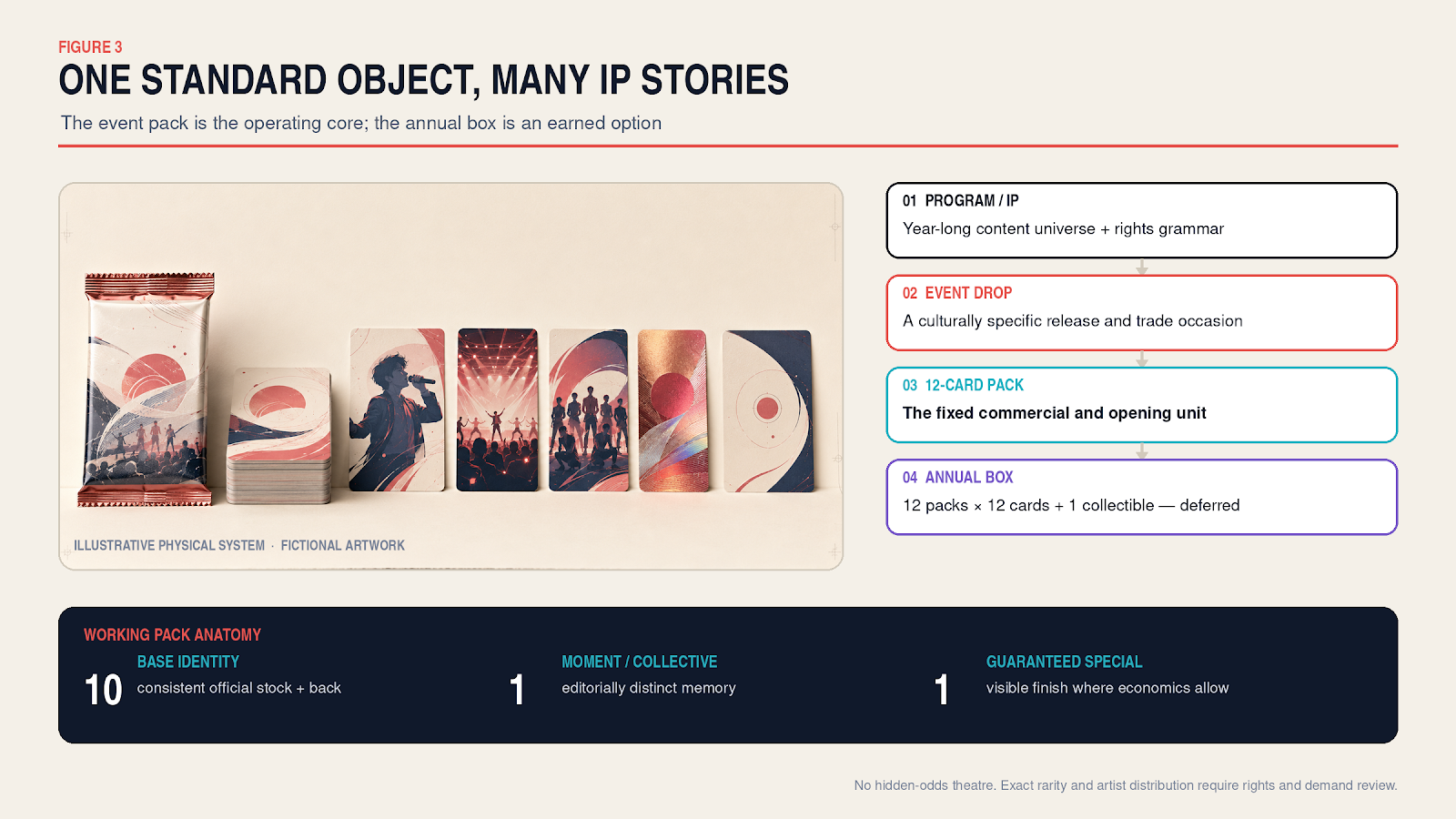
| Slot | Working count | Role |
|---|---|---|
| Base identity | 10 | Artists, characters, quotes, lyrics, memes or era markers on one consistent official physical grammar. |
| Moment / collective | 1 | Performance, episode, concert or ensemble memory. |
| Special / chase | 1 guaranteed | Visibly differentiated pull such as foil, holo or texture where economics allow. |
The slot structure is a working collation hypothesis, not a final odds table. Exact rarity, artist distribution and variants remain production decisions after rights, content and demand review.
#3. Boundary Versus the Event Joining Card
| Dimension | Event Joining Card | Fandom Card |
|---|---|---|
| Meaning | “I was there.” | “This is who or what I support.” |
| Supply | Controlled and event-linked. | Broad enough for circulation and repeated drops. |
| Identity binding | May be required to prove participation/history. | No owner identity required. |
| Transfer | Not the core behavior. | Free pass, gift and trade are core behaviors. |
| Value source | Verified memory and milestone meaning. | Identity, collectibility, culture and exchange. |
| Data | User/event/card history. | SKU, batch, sales, quality and aggregate behavior signals. |
Design boundary: do not bind the everyday Fandom Card to the Event Joining Card history system. One needs controlled provenance; the other needs frictionless circulation.
#4. Authenticity Through a Manufacturing Signature
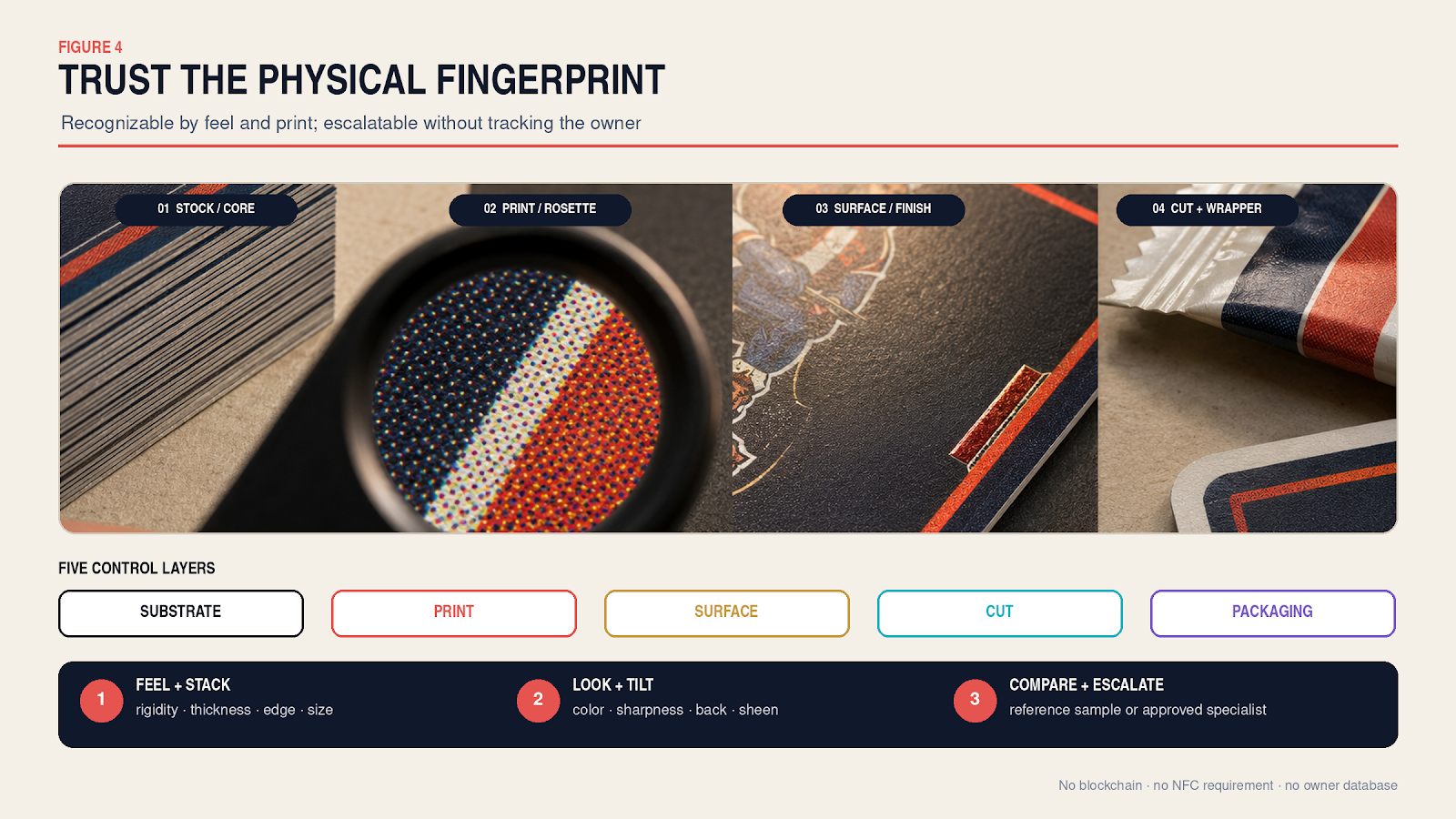
V2 drops the assumption that every card needs a premium anti-counterfeit device. The pilot instead establishes a reproducible physical fingerprint that fans can learn and that the company or a specialist can inspect more deeply when a dispute occurs.
The signature spans:
- Substrate: stock family, thickness/caliper, weight range, opacity, stiffness and internal core.
- Print: color targets, black density, sharpness, halftone/rosette, registration and back alignment.
- Surface: gloss/matte level, texture and coating response.
- Cut: dimensions, corner radius, centering and edge cleanliness.
- Packaging: wrapper film, seal, print, batch/lot mark and official reference.
#Fan-facing three-step check
- Feel and stack — compare rigidity, thickness, edge/core, size, cut and surface against a known official card.
- Look under normal and angled light — compare color, text sharpness, back alignment, print pattern, gloss/texture and wrapper seal.
- Escalate disputed cards — compare with official references/retained samples or an approved specialist; no account binding is required.
Pilot rule: no blockchain, crypto or ownership transfer. No NFC requirement. Holo or texture may identify a special content tier, but the official manufacturing signature must exist across the entire product family.
#5. Drop Occasion and Everyday Circulation Test
An event or concert is a useful launch catalyst because it supplies fresh cultural content, concentrated demand and a shared context. It is not the only place where the product should create value.
The operating loop is:
Select → compose → produce → release → circulate → observe → decide.
The pilot can still provide one light and fair exchange opportunity — for example a clearly signed table or short trade hour — without making rewards or attendance contingent on trading. But the broader test continues after the event.
Everyday circulation is observed through behavior: did buyers keep and carry cards, gift or share them with friends, display them in phone cases/card holders/bags, photograph or post them, trade duplicates, trigger conversations, or return for another drop?
Social-object kill rule
If packs sell but both the designed interaction opportunity and post-drop daily circulation remain weak after one reasonable iteration, kill the broader social-object thesis. Continue only as merchandise if the direct economics justify it.
A weak trade table alone is not enough to kill the idea; Vietnamese fan behavior may express itself through friend-to-friend gifting, school/social-group exchange, carry/display or UGC instead. DatVietVAC should support emergence, not declare a community into existence. A marketplace, grading service, price index, resale guarantee, reseller program or always-on creator network should not be the first move.
#6. Pilot, Measurement and Economics
#Working 90-day pilot
- Program / IP: one active program with visible demand and enough artist/moment variety.
- Occasion: one event or concert-linked launch for the pilot, followed by explicit post-drop daily-circulation observation.
- Pack: one sealed 12-card pack.
- Checklist: approximately 30 outcomes as a starting hypothesis.
- Price: one public MSRP; VND89K preferred working anchor when it protects the official quality bar. VND79K is a value-engineering sensitivity only if material, print, finish, packaging and rights economics remain credible.
- Run: 3,000 packs + pre-agreed reprint option.
- Channel: VieSHOP + one event touchpoint.
- Circulation: checklist + light creator seeding + one optional exchange touchpoint + sampled post-event observation of carry/share/display/gift/trade behavior.
- Technology: no owner system; physical manufacturing signature first.
- Annual box: excluded from pilot.
#Everyday circulation signals
Track a small set of post-checkout behaviors without building an owner ledger: carry/display, share/gift, trade, organic photo/story/UGC, interaction outside official events, “someone asked me about the card,” and repeat purchase for self or another person. Use sampled surveys, interviews and pilot observation rather than tracking each physical card owner.
#Five pilot gates
| Gate | What it must show | If weak |
|---|---|---|
| Paid demand | Healthy sell-through plus repeat/reprint intent without excessive discount dependence. | Rework price/value/channel once, then stop. |
| Product + trust | Worth-price response, repeatable official quality and acceptable defect/authentication outcomes. | Fix spec/vendor before another drop. |
| Behavior + belonging | Credible trade/gift/display/content and recognition/interaction beyond seeded activity. | Kill community thesis after one designed iteration. |
| Economics | Positive path after physical COGS, rights/royalty, payment, handling, shipping and inventory risk. | Requote, re-spec or stop. |
| Operations + rights | Clean approval cycle, on-time delivery, correct collation, retained references and repeatable rights/production process. | Hold portfolio expansion. |
#Two ledgers, not one blended story
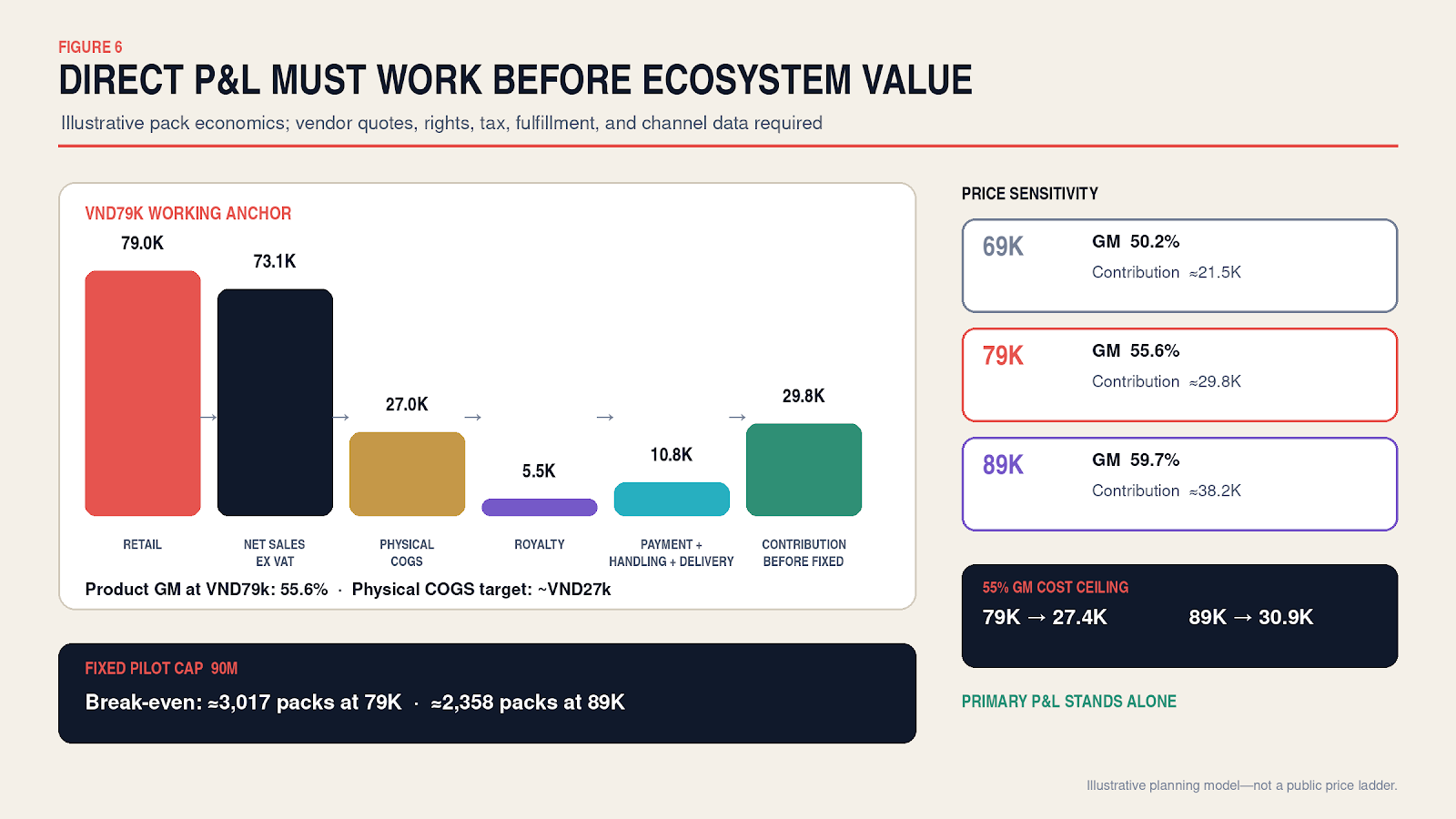
- Direct Card P&L: pack revenue; physical card/pack COGS; rights/royalty; payment; handling; delivery subsidy; returns/write-off; pilot/team allocation. It must become economically defensible on its own.
- Ecosystem Impact: organic content, carry/display, gift/share, trade, creator repetition, interaction inside and outside official events, artist/program resurfacing and directional cross-purchase. Measure separately; do not invent VND value to hide weak merchandise economics.
#V2 pack-economics sensitivity
The case uses a planning sensitivity, not a public price ladder. With an illustrative VND27K physical build, the planning sensitivity estimates product GM around 59.7% at VND89K and 55.6% at VND79K, before payment/handling/delivery subsidy and fixed pilot cost. The higher anchor is preferred only if fans can visibly feel the official quality difference; actual tax treatment, artist contracts, logistics, GM hurdle and supplier quotes remain internal validation dependencies.
#7. Operating and Rights Architecture
#One accountable third party
Own the specification and acceptance. Outsource the industrial chain through one accountable lead partner.
For the pilot, DatVietVAC should avoid splitting prepress, printing, finishing, collation and pack assembly across loosely coordinated vendors. One lead specialist manufacturer/packer should contract for the full physical delivery under a single SOW, even when it uses disclosed subcontractors.
DatVietVAC retains control of final art, rights approval, physical fingerprint, proof sign-off, substitution approval, collation rules, audit samples, lot traceability requirements, retained references and reject/rework decisions.
#Rights cannot be outsourced away
Legal/IP must confirm which artist likenesses, lyrics, quotes, memes, episode stills, music-related imagery and sponsor marks may be commercially reproduced. The rights design should distinguish:
- drop-specific use versus later annual compilation/reprint/reuse;
- whether artist compensation is already included or must be itemized as fee/royalty;
- file custody and subcontractor limits;
- pack-level sales/returns and royalty reporting;
- fresh approval requirements for a later annual box.
#8. Earn the Right to Scale
A successful pilot unlocks another controlled drop — not an annual box and not a standalone venture.
The scale ladder is:
0 — Prototype → physical fingerprint, 12-card pack, checklist, vendor proofs and fan/WTP research.
1 — Drop pilot → one IP/occasion, one MSRP, 3,000 packs, light interaction opportunity, post-drop circulation observation and full gate review.
2 — Repeated product line → recurring drops, standardized issuer back/spec/SOW, artist/occasion demand tracking, everyday-circulation signals and mini-P&L.
3 — Conditional annual box → 12 sealed packs × 12 cards + one collectible for a proven year-long program, only after box-design evidence passes.
4 — Collectibles pod → portfolio strategy, distribution, creator/community support and dedicated P&L after multiple programs sustain releases.
5 — Selective internalization → bring high-value control points in-house only when control is economically superior to specialist outsourcing.
#Annual box remains a principle, not a pilot product
The annual box follows the program, not one isolated concert. Design work is unlocked only when multi-drop evidence supports:
- repeated pack demand and repeat buyers;
- artist/event demand breadth rather than one hot individual;
- enough distinct, rights-cleared annual content for 144 cards to remain meaningful;
- buyer fairness for existing collectors;
- intentional inventory/reprint policy;
- viable economics;
- clean compilation rights and third-party production capability.
Exact checklist, pack mix, rarity, exclusives, print run, price and cannibalization policy remain deferred.

#9. Decision Memo
Recommendation: test the initiative as a contained 12-card official fandom-pack pilot, using an event/concert as the launch catalyst but measuring what happens after the product enters everyday life.
Before print: clean asset-level rights; approved physical fingerprint; acceptable third-party proof; capped pilot economics; clear collation/pack promise.
Working price: prefer VND89K when it protects a visibly better official quality bar; use VND79K only as a value-engineering sensitivity if the quality difference remains credible.
Kill the broader social-object thesis if: both designed interaction and post-drop carry/share/display/gift/trade signals remain weak after one reasonable iteration.
Another drop is earned only when: paid demand, repeat/reprint interest, recognized official quality, positive economic path, clean rights, repeatable operations and at least credible circulation evidence appear together.
Annual-box design is earned only when: multi-drop pack sales, repeat buyers, artist/occasion demand evidence, annual content depth, buyer fairness, clean compilation rights, inventory plan and viable economics support it.
Manager-seat principle: manage the initiative as a sequence of earned options. Keep the fan job, product specification, rights, supplier accountability, unit economics, release calendar, circulation evidence and scale decision connected.

#Evidence Boundary
Public evidence supports company context, current product observations, global authentication practices and market/manufacturing precedents. It does not prove DatVietVAC demand, achievable cost, rights coverage, card odds, box viability or community effects.
Known from public sources: company-reported IP/event/distribution ecosystem; current public merchandise examples; external authentication and manufacturing mechanisms.
Observed in the case research pull: one Anh Trai Say Hi Shopee listing from one seller showed more than 30,000 units sold, with many other products/sellers visible but not exhaustively captured. Treat this as directional demand evidence only, not market size or proof of authorization status.
Outside-in hypotheses: 12-card social-inventory consumer job; VND89K preferred price viability with VND79K sensitivity; physical COGS; everyday-circulation mechanism; single-third-party operating design.
Must validate internally: IP/artist rights, actual COGS and fixed budget, GM hurdle, pack demand, circulation behavior, collation, defect tolerance, box eligibility and operating ownership.
#Full Case
Independent outside-in work sample · Public evidence only · Updated 16 August 2026